
by Matthew Russell - Posted 5 months ago
Welcome, my CryptoComics Compatriots. One of the lessons I teach in my Graphic Novel class centers around a simple question: what actually makes a good story?
At first, most students want to talk about the visuals. That makes sense. I get it, I really do. Comics are a visual medium. Great character designs, dramatic poses, dynamic panel layouts, and eye-catching covers all matter. Strong artwork can absolutely make someone stop and pay attention.
When we talk about great comic runs, a lot of us instantly start talking about a favorite artist. Personally I love the phenomenal work from Chad Hardin.

Death Watch is Chad Hardin’s creator-owned series, following Ryner Cushing, a 19th-century vampire hunter battling creatures and darkness across Europe. It has that big, dramatic comic-book energy on the page, but it also feels grounded in a story world that immediately makes you want to know what happens next.
But attention and investment are not the same thing. I only bring up Death Watch because I love the artwork. The writing is great as well, but I wanted to bring up the artwork first.
Anyway, a reader might pick up a comic because the art looks incredible. They keep reading because they care about what happens next.
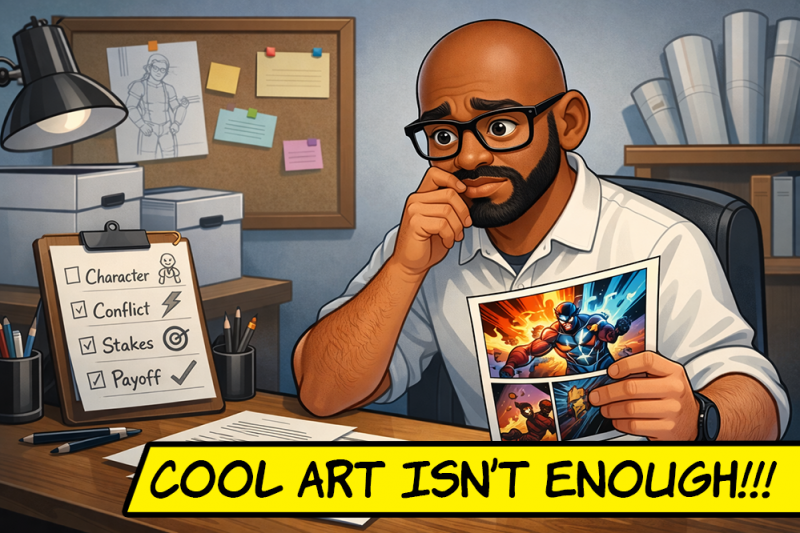
That is the big idea I come back to in class. Cool art might get someone to open the book, but story is what gets them to keep turning pages.
A lot of people buy comics and graphic novels because of the artwork. That part is real. Art sells first impressions. It helps create mood, style, energy, and identity. In comics, the visuals are not decoration. They are part of the storytelling itself.

But no matter how good the art is, it cannot fully cover for a weak story. If there is no tension, no purpose, no reason to care, readers feel it. They may not always be able to explain why a story fell flat, but they know when something looks cool and still leaves them cold.
That happens when the story underneath the visuals is missing its foundation.
A good story usually starts with a character who wants something. That goal does not have to be world-shattering. It can be saving a friend, proving something, surviving a bad situation, finding the truth, or just making it through the day. What matters is that the character wants something clearly enough that the reader can follow it.
Now, something needs to get in the way. That is where conflict comes in. Conflict is the engine of story. Without it, things just happen. With it, choices matter. The character has to struggle, react, adapt, and sometimes fail.
Then the story needs stakes. Why does this matter? What happens if the character fails? What could be lost? If the answer is “not much,” the reader will feel that too.
Good stories also build. The middle should not feel like the character is running in circles. The pressure should rise. The problems should get harder. The choices should become more difficult.
And by the end, something should change. Maybe the character changes. Maybe the world changes. Maybe the reader sees the situation differently than they did at the start. Whatever the case, a story should feel like it moved. One of the best stories I read, nothing in the world changed except the character’s POV. There was a level of acceptance.
When I talk to students about a story, I try to strip it down to the essentials Q & A.
Who wants something?
What gets in the way?
How do things get worse?
The characters have to make what choices?
Those choices cost something, so what is it?
You can dress it up with superheroes, monsters, romance, sci-fi, horror, comedy, or high fantasy. You can build the wildest world imaginable. But if there is no heart underneath it, the whole thing starts to feel hollow.

This is especially important in comics because strong art can sometimes fool creators into thinking the story is already doing more than it is.
A splash page can look amazing. A character design can be unforgettable. A fight scene can have all the energy in the world. But if the reader does not care who is fighting, why it matters, or what is about to be lost, the moment will not hit the way it should.
The best comics do both. They give you something great to look at and something meaningful to follow.
That is when the art and the story stop competing and start working together.
Readers do remember great artwork. Of course they do. Usually, the moments that stay with them are more than just images.

They remember the reveal that changed everything. The decision that cost the hero something real. The quiet conversation that made a character feel human. The ending that landed exactly where it needed to.
Those moments hit harder because the story earned them.
That is what I want my students to understand, and honestly, it is something all of us as creators need to remember from time to time.
Cool art is powerful. In comics, it absolutely matters. But cool art is not enough!
Story is what gives the art weight. Story is what gives the reader a reason to care. Story is what turns a series of impressive images into something people actually remember.
And that is when a comic starts to become more than something that looks good. That is when it starts to matter.

